Today, in my Native
American Studies class, my teacher taught us about Native American governance,
specifically for the Hopi tribe. As I was sitting there, listening to him
describe a way of life that was completely foreign to me, I realized, one of
the books I'm reading right now, called Son by Lois Lowry, has an incredibly
similar social structure. Even though Lowry's book is set in the future and Hopi's
have been living this way for hundreds of years, I could see the
comparison.
To set up the scene:
In The Giver series, in which Son is the final book, the world is presented as a Utopian society.
Each year, exactly 50 children are born from Vessels, or Birth Mothers. These
women live together in a setup similar to a dormitory.
Once the children are a
year old, they go to their first Ceremony to be named and assigned to a family.
Each group of parents is assigned one male child and one female child
throughout their years as parents.
The children go through
phases of life together, all getting jackets with pockets at age seven so they
can be responsible for their own possessions, bikes at age nine, the exact same
haircuts at age ten, and finally being assigned their career paths at age 12.
Once a child has been assigned, he or she stops learning a diverse set of
subjects in school and begins, instead, to learn only the knowledge needed for his or her
career, knowledge which no one outside of that career can know.
In comparison, in Hopi
society, children are given a name at their Naming Ceremony. Years later, they are initiated into society to learn their clan's knowledge. If
adults are talking about Hopi traditions, rituals, or knowledge and a child who
isn't initiated yet walks into the room, the adults stop talking because that
child has yet to be given the right to that knowledge.
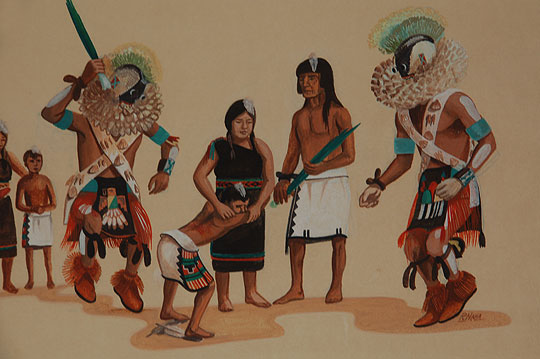
Hopi Initiation Ceremony
Around the age of 9, 10,
or 11, Hopi children are initiated along with the other children of that age
group who are ready for both the knowledge and responsibilities that being a
part of their clan entails.
They way these parts can
be compared, coming from two completely different societies struck me. I began
to wonder, how many writers travel or research another culture's way of life
and then present their take on that society as fiction. If you had asked me
prior to learning about the Hopi, I would have said that The Giver's Ceremonies
sounded completely original to me. But now that I know similarities exist, it
makes me wonder what others are out their in other cultures and in other
stories.

No comments:
Post a Comment